
Morality Is Not Neutral
Class, Crisis, and the Fight for a New World

I’m publishing the lead-off speech I delivered to my Brussels branch of the Revolutionary Communist International (RCI). It’s time to organise. Find your local branch — we are currently organising in more than 70 countries worldwide. We are looking for the most advanced layers of the working class to help build a revolutionary alternative.
We are told, constantly, that morality is something eternal. That it exists above society, above history, above class. That it applies equally to everyone, in all times and all places. But if we look seriously at the world around us today, that claim begins to fall apart.
When Luigi Mangione killed the CEO of UnitedHealthcare, something remarkable happened. Millions of people did not instinctively sympathise with the victim. Instead, they asked a different question: what kind of system produces this level of anger? That shift matters. It signals a break with the moral reflexes that have long sustained the existing order. At the same time, when governments declare that “violence is never the answer,” while funding wars, occupations, and repression across the globe, people see the contradiction more clearly than ever.
And when economists lecture society about rationality and responsibility after years of failed predictions, we are told the problem lies not in their modules, but in our understanding. Yet the truth is much simpler: their modules no longer correspond to reality. And increasingly, their morality does not either.
To understand this crisis, we have to start from a basic Marxist premise: morality is not eternal. It is historical. It is social. And above all, it has a class character.
What any society considers “moral” is deeply rooted in how that society organises production and life itself. Practices that today are universally condemned — such as slavery — were once not only accepted but considered entirely legitimate, even respectable. In earlier forms of society, under conditions of extreme scarcity, even practices like infanticide existed as grim responses to material necessity. These are not simply differences in opinion or culture. They reflect changes in how human beings produce, survive, and organise their social relations.
As Leon Trotsky explained, morality is the product of social development. It evolves as the material conditions of society evolve. And this immediately raises a second, crucial point: morality is not only shaped by history, but also by power.
Morality does not arise in a vacuum above society, but from the real struggles between classes. What is considered “right” or “wrong” in any given epoch ultimately reflects the interests of the dominant class, which presents its own position as universal. Marxists do not deny morality, but they reject the idea that it is fixed, eternal, or independent of material conditions. Instead, morality is understood as a product of social relations — and therefore as something that changes when those relations are transformed.
We can already see this process unfolding in real time. In my country Sweden today, legislation is being introduced that lowers the age of criminal responsibility, allowing children as young as 13 to be imprisoned. Presented in the language of “security,” “order,” and “moral responsibility,” this shift does not reflect a neutral ethical evolution, but a political response to social tensions. What is defined as “crime,” and who is deemed punishable, is being pushed downward in age as part of a broader punitive turn. It is a clear example of how moral categories are reshaped by material and political pressures, rather than standing above them.
As Karl Marx and Friedrich Engels argued, the ruling ideas of any epoch are the ideas of the ruling class. Morality is one of those ideas. It presents itself as universal, as neutral, as applying equally to all. But in reality, it reflects and protects the existing social order.
Take something as seemingly obvious as the commandment “do not steal.” This appears timeless, almost self-evident. But the very concept of theft only makes sense in a society based on private property. And once private property exists, the institutions of society — the state, the law, the police — are organised to defend it. Morality, in this sense, becomes a tool. It condemns the actions of the oppressed when they violate property relations, while legitimising the far greater expropriation carried out by those who own and control wealth.
This is why hypocrisy is not an accidental feature of class society. From a Marxist standpoint, the working class develops its own moral outlook through struggle — one that is not based on abstract rules, but on solidarity, collective interest, and the necessity of transforming society.
As Trotsky argued in discussions on revolutionary morality, the working class does not adopt the morality of the ruling class, but creates its own standards rooted in the struggle for emancipation. Or, in his formulation, “our morality is subordinated to the interests of the proletarian class struggle.”
This does not mean “anything goes,” but rather that morality is judged by its relation to historical progress: “does it strengthen collective struggle, or weaken it?”
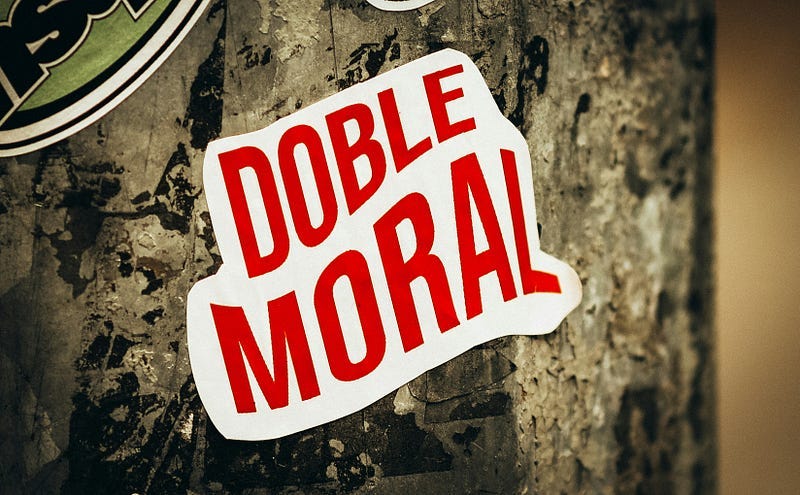
Every ruling class presents its morality as universal and binding for all, but consistently violates it when its own interests are at stake. The Church preached humility while accumulating immense wealth. Liberal democracies preach human rights while waging imperialist wars. Politicians condemn violence while presiding over systems that depend on it.
This contradiction is tolerated, even internalised, for long periods — so long as the system itself appears to function, so long as it develops the productive forces and provides a certain degree of stability. Under those conditions, the moral framework of the ruling class can appear to “make sense,” even to those it exploits.
But when a system enters into crisis — when it can no longer develop society in a progressive way — that moral framework begins to disintegrate. The hypocrisy becomes too obvious. The gap between words and reality becomes too wide to ignore.
This is precisely the situation we are living through today. Capitalism is no longer able to present itself as a system of progress, stability, or rationality. Its crises are economic, political, and increasingly moral. The breakdown of economic modules is one expression of this.
Another ideological framework that becomes especially prominent in periods of crisis is utilitarianism — the idea that morality can be reduced to calculating outcomes, typically in terms of “greatest happiness” or “greatest good for the greatest number.” At first glance, this may appear rational and scientific. But in practice, utilitarian reasoning often mirrors the logic of capitalism itself: it abstracts away from power relations and treats outcomes as neutral quantities, while ignoring how those outcomes are produced and who decides what counts as “good.”
In capitalist society, utilitarian arguments are frequently used to justify inequality and violence: austerity is framed as “necessary for long-term stability,” wars are justified as “preventing greater harm,” and exploitation is defended as “increasing overall efficiency.” In reality, this is not morality — it is the moral language of an already existing system of domination.
From a Marxist perspective, the problem is not that consequences do not matter, but that consequences cannot be separated from class power. A system that produces immense suffering for many in order to benefit a few cannot be justified by aggregating “net outcomes.” It must be judged by its social relations, not its statistical outputs.
When leading economists repeatedly fail to predict outcomes, and yet continue to insist on the validity of their frameworks, we are not dealing with science in the true sense, but with ideology defending itself against reality.
And what is striking is that even voices within the establishment are beginning to admit this — sometimes almost despite themselves. Just this past week, the widely circulated Eurointelligence newsletter, read across EU institutions, made a remarkably blunt admission:
“We are all happy to engage in intellectual debate, but after a long string of forecast errors, international macroeconomists are in no position to lecture anyone about our intellectual deficit.”
And they go further. The issue, they notify us, that it is not whether critics lack the intellectual capacity to understand the economic modules, or cannot read what the petty-bourgeois economists are writing. The issue is far more fundamental: these modules are no longer consistent with the data. In other words, reality itself is slipping out of the framework that is supposed to explain it. And when that happens, it is not just economic theory that enters into crisis — but the entire ideological and moral order built upon it.
We see the same pattern in politics. Even figures like Donald Trump reflect this contradiction in a distorted way. His economic policies may be short-term, unsustainable, and driven by speculation and debt. But politically, they resonate with millions of people who have lost faith in institutions, experts, and the moral authority of the establishment. The support he receives is not primarily an endorsement of his programme, but an expression of distrust toward a ruling class that is widely seen as hypocritical and self-serving.
And once again, even sections of the establishment media are forced to acknowledge this reality, however reluctantly. The same, again, widely shared newsletter of the EU-bubble: Eurointelligence notes, with striking frankness, that
“Trump’s economic record during his first term was good… the much predicted disaster from tariffs did not happen.”
They go on to admit that the standard modules fail to account for what is actually driving the economy today, pointing to factors like financial flows that sit outside their frameworks. And the conclusion they draw is revealing: Americans, they say, will overlook wars, scandals, and outrage “as long as he, Donald Trump, delivers on the economy.” In other words, even from within the petty-bourgeois press, we are told plainly: the system may be irrational, unsustainable, even contradictory — but if it produces growth in the short term, it maintains political support. That is not a defence of the system. It is an indictment of it. The ultimate crime: the capitalistic and imperial system. That is the ultimate crime.
It is crucial to understand that this rejection of official morality does not represent a collapse into nihilism. It is not simply that people no longer believe in anything. On the contrary, it reflects a growing moral revulsion against the existing order. People sense, often instinctively, that the system is unjust, that its rules are rigged, and that its moral claims are fraudulent.
In such periods, morality itself becomes a battlefield. The abstract, universal principles promoted by the ruling class begin to lose their hold, and new forms of moral consciousness emerge — rooted in lived experience and struggle. We see this most clearly in moments of collective action. During strikes, for example, the idea of abstract “fairness” gives way to a concrete sense of solidarity among workers and a clear recognition of opposing interests. There is, as comrade Bissonnette puts it, a morality of the picket line — stronger and more real than any abstract moral code, because it is grounded in material reality and collective struggle.
This is where the perspective of Leon Trotsky becomes decisive. For Marxists, morality cannot be separated from the struggle between classes. What is moral is not determined by abstract rules, but by whether an action advances the consciousness, unity, and capacity of the working class to transform society. The ends and the means cannot be separated in the abstract — they must be understood in relation to historical development.
This brings us to one of the most contentious questions: violence.
Marxist theory has always insisted that moral categories must be understood concretely, not abstractly. Violence, legality, and legitimacy cannot be evaluated in isolation from the class relations they serve. The bourgeoisie naturalises its own violence — police, prisons, war — by defining it as order, while defining resistance as chaos. But Marxists reverse this perspective: what matters is not the abstract form of violence, but its historical function within class society.
The ruling class insists that violence is always immoral, always unacceptable. But this claim collapses the moment we look at reality. Capitalism is founded on violence — historically through conquest and colonisation, and in the present through the coercive power of the state. The police, the military, the prison system — all are expressions of organised violence.
The real question, therefore, is not whether violence exists, but whose violence we are talking about, and for what purpose. The violence used to maintain exploitation is not morally equivalent to the violence used to end it. To treat them as the same, as pacifism often does, is to side objectively with the status quo.
This contradiction becomes especially visible in movements like Black Lives Matter. The slogan itself expresses a simple moral truth: that lives systematically devalued by the state and society must be recognised as equal. Yet the response to such movements exposes how “morality” functions under capitalism. Police violence, mass incarceration, and structural racism are treated as institutional necessities, while protests against them are often framed as disorder or excess.
What BLM reveals is that the state does not merely enforce laws — it enforces a hierarchy of whose lives matter in practice. The official moral language of equality coexists with a material reality of inequality and coercion. In this sense, the demand that “Black Lives Matter” is not just a moral appeal, but a political challenge to the structure of state power itself.
Attempts to respond to such movements through purely moral language — calling for “understanding,” “dialogue,” or “unity” — miss the point. The issue is not a lack of shared values, but a social system that systematically produces unequal lives. Here again, morality becomes a battlefield between abstract universalism and concrete social reality.
At the same time, rejecting abstract pacifism does not mean embracing all forms of violence indiscriminately. Individual acts — however understandable they may be as expressions of anger — do not in themselves challenge the system. As in the case I mentioned earlier of Luigi Mangione, the anger behind such an act is real and widely shared, but the act itself does not dismantle the structures that produce that injustice. Individuals can be removed; the system remains.
In fact, such actions can even be counterproductive if they substitute the actions of a few for the collective organisation of the many, or give the state a pretext to strengthen repression. The transformation of society requires not isolated acts, but conscious, collective struggle on a mass scale.
There is also an important warning here for the Left. In recent years, we have seen a tendency to replace political strategy with moral judgement — to focus on purity, on policing behaviour, on internal criticism detached from broader struggle. This reflects the pressure of bourgeois ideology, which seeks to fragment and weaken movements by turning them inward. But a movement that prioritises moral performance over organisation and struggle cannot succeed. As Trotsky insisted, a revolutionary must break morally from bourgeois public opinion, not adapt to it.
So where does this leave us? It would be a mistake to idealise the masses. They are not always consistent, not always conscious, not always moving forward. History does not proceed in a straight line. There are periods of advance and periods of retreat, moments of clarity and moments of confusion. But through these contradictions, something fundamental develops: the capacity of human beings to collectively reshape society.
Our task is not to stand outside this process and judge it according to abstract standards. Our task is to participate in it consciously, to understand its dynamics, and to help give it direction.
Let me end on this note.
We have seen history surge forward, and we have seen it fall back. We have seen movements rise with extraordinary courage — whether in Sudan, where masses overthrew a dictatorship only to face the brutal consequences of counter-revolution, or in Palestine, where generations have resisted occupation under conditions of unimaginable violence — and we have also seen how these struggles can be pushed back, fragmented, or betrayed. In Sudan, the refusal to break decisively with the old state and arm the masses left the revolution exposed to reaction, plunging the country into a devastating civil war. In Palestine, the daily reality of oppression reveals with absolute clarity the hypocrisy of a world order that condemns resistance while enabling and arming domination. These are not distant tragedies; they are concentrated expressions of the same global system.
From this, a clear lesson follows: history does not bend to abstract moral principles. It moves through the balance of social forces.
The masses are not perfect, and we do not romanticise them. They carry both the potential for collective transformation and the weight of the society that shaped them. It is through this contradiction — not outside it — that change becomes possible.
Our task is not to judge from above, but to engage within this process consciously: to strengthen organisation, deepen understanding, and contribute to the development of collective power.
Because systems do not fall simply because they are unjust. They fall when people become organised and conscious enough to overturn them.
To participate in that process — clearly, collectively, and with full awareness of its difficulty — is not only a political task.
It is the highest form of moral commitment.
And to conclude with a quote from comrade Leon Sedoff that resignates a lot with me — “to participate in this movement with open eyes and with an intense will — only this can give the highest moral satisfaction to a thinking being!