
What is Protest For?
Vincent Bevins on why popular resistance movements fail


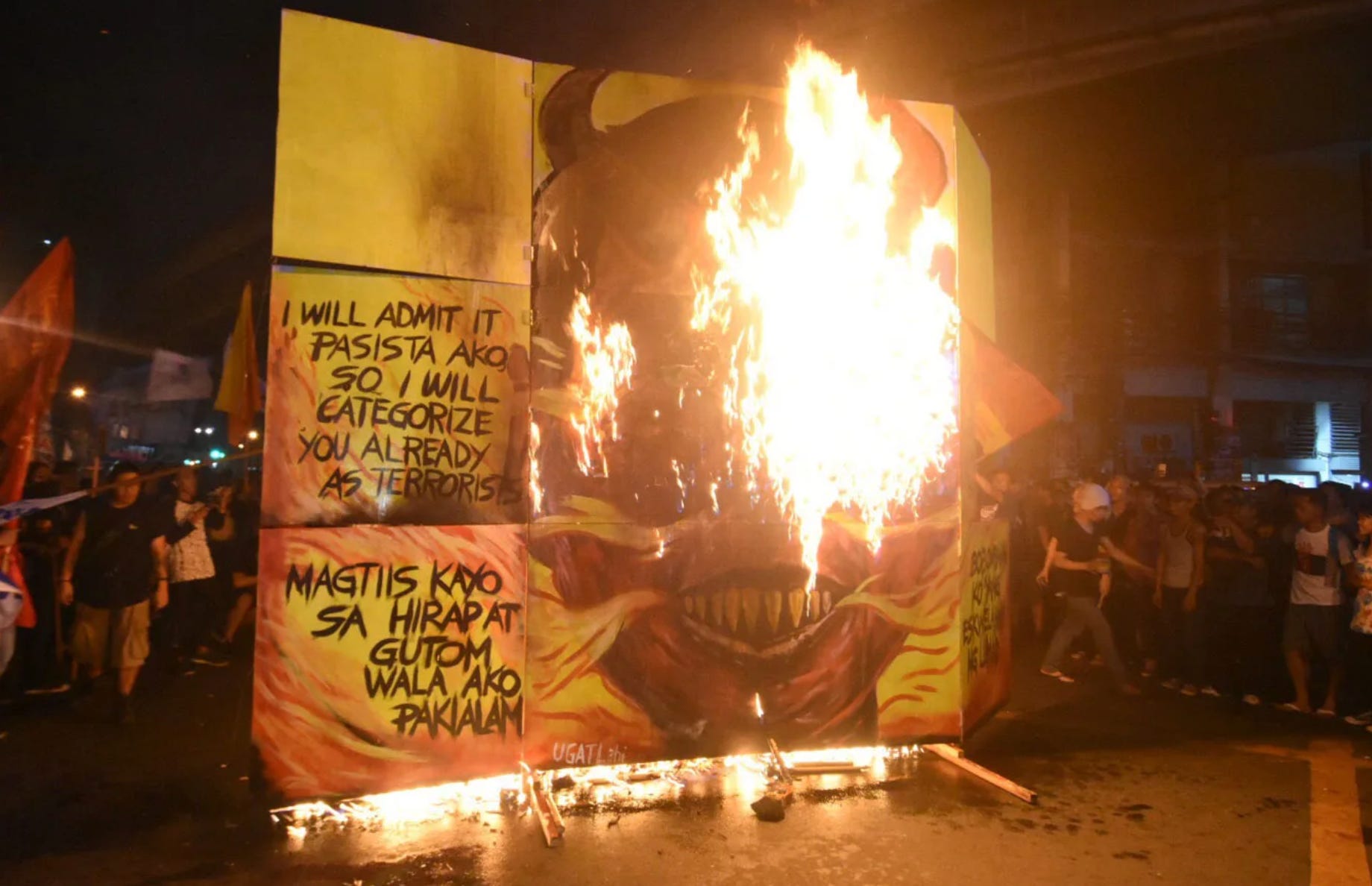
When an old order collapses or even trembles, something will come next. A vacuum does not remain empty. And if that vacuum is not filled by a force capable of building and protecting something better, it is usually filled by something far worse. The history of the last decade (2010–2020) — one of the most protest-filled periods in modern times — makes this reality unavoidable. And we most likely are heading into a bigger mass protest decade.
One reviewer captured the significance of Vincent Bevins’ If We Burn by saying, “The highest praise I can give If We Burn is to say that it would be criminally negligent not to read it if you’d like to change the world.” It is difficult to disagree. Bevins has not written a triumphant recounting of global revolt, nor a romantic celebration of people rising up together. Instead, he offers what is more politically necessary: a sober, incisive examination of why one of the greatest wave of mass mobilization in recent memory did not lead to the transformations so many hoped for. In many places, those uprisings even produced outcomes more repressive, more chaotic, and more dangerous than the regimes they challenged. The vacuum, in short, was left unfilled.
Bevins takes readers across a world set ablaze: Cairo, Santiago, Istanbul, Kyiv, Tunis, Hong Kong. These were not minor disturbances. They were moments in which millions poured into the streets with a sense that history had opened, finally, to possibility. They toppled governments, shook authoritarian regimes, and inspired those far beyond their borders.
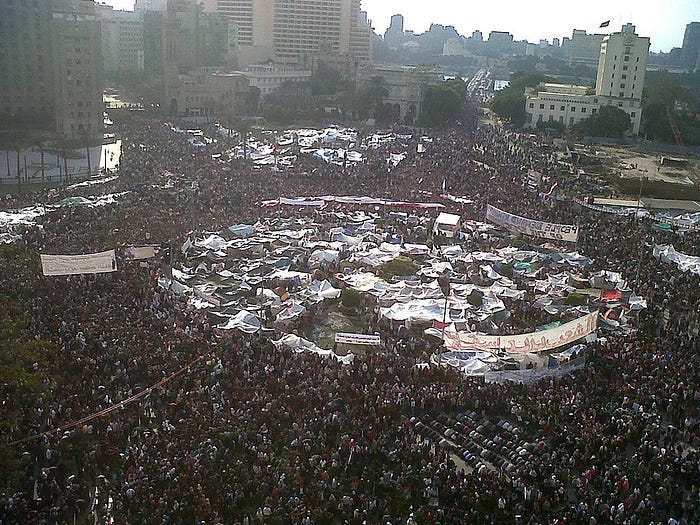
Yet, as Bevins shows with relentless clarity, the results were uneven at best and catastrophic at worst. Egypt’s uprising ended with a military dictatorship harsher than Mubarak’s. Brazil’s 2013 protests led not toward progressive change but to the political crisis that empowered the far right. Ukraine’s hopeful movement spiraled into war. Bahrain was crushed with horrifying force. Even uprisings that appeared successful often left behind fragile landscapes easily captured by reactionary forces. What remains today is not a world transformed by democratic breakthroughs, but one haunted by the memory of what might have been.
To understand why, Bevins looks beyond the protests themselves and toward the global political-economic order in which they unfolded. After the Cold War, a single model of political “common sense” dominated international institutions, Western governments, and global elites.
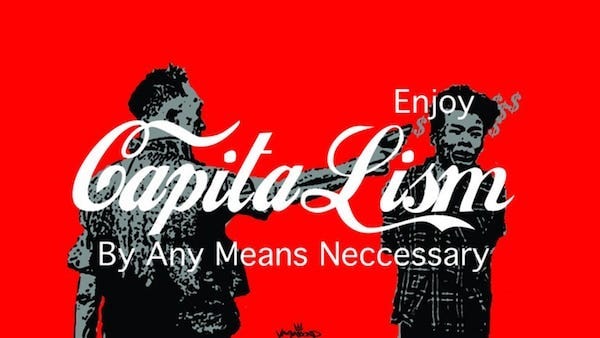
Neoliberal capitalism — privatization, austerity, free movement for capital but not for people — became the default, its legitimacy never to be questioned. In this context, many protestors entered the streets without visible alternatives. Not because they lacked imagination, but because most alternatives had been systematically delegitimized or dismantled. The labor movements and political parties that once anchored popular power had been weakened. Ideological frameworks had been hollowed out. Institutions built for collective strategy had decayed.
Bevins reminds us that the collapse of the Eastern Bloc was widely misunderstood. Those on the streets in 1989 wanted freedom, dignity, sovereignty, and the ability to shape their own lives. They were not asking for a rapid plunge into unregulated capitalism and Wall Street. Yet that is what they received. What rushed into the vacuum was a new global order that protected investors more than citizens, stability for elites more than sovereignty for nations.
Earlier in the book, Bevins revisits Indonesia in 1965, where the annihilation of the world’s largest communist movement outside China and the Soviet Union was not a spontaneous eruption of violence but a coordinated project carried out by General Suharto’s army with direct support from the United States and its allies. Over the course of several months, the Indonesian military and affiliated militias systematically hunted down members of the Indonesian Communist Party (PKI) — along with trade unionists, peasant organizers, left-wing intellectuals, ethnic Chinese Indonesians, and anyone who could be labeled “communist” — killing at least 500,000 people, with some estimates reaching into the millions.
Declassified documents and testimonies show that U.S. officials supplied the Indonesian army with weapons, intelligence, radio equipment, and — most chillingly — lists of thousands of alleged leftists to be targeted. American, British, and Australian diplomats openly celebrated the massacre, seeing it as a decisive victory in the Cold War and a green light for opening Indonesia to foreign capital. Suharto’s dictatorship, installed through this bloodletting, quickly implemented policies that aligned perfectly with Western economic interests: privatization, deregulation, and a brutally repressive security apparatus to keep labor and popular movements in check.
In Bevins’s argument, this moment — explored in depth in his earlier book The Jakarta Method (2021) — became an early template for the neoliberal world to come: a political and economic order constructed through mass violence, legitimized by the language of stability and modernization, and upheld by an international system ready to protect compliant regimes. Understanding this history is essential to grasp why uprisings in the 2010s so often faltered. They were confronting not merely local dictatorships, but a global architecture of power built precisely to absorb, undermine, or annihilate dissent long before it could threaten the economic and geopolitical status quo.
The core of If We Burn examines the great uprisings of the 2010s, which were frequently celebrated as the dawn of a new revolutionary era. At the time, commentators claimed that social media had fundamentally transformed political struggle. Movements could emerge overnight, grow with astonishing speed, and overwhelm authorities before they could respond. The slogan “the revolution will be Twittered” seemed to capture this sense of possibility.

Yet what looked like an advantage in the beginning became a trap. Digital tools made it easy to mobilize but far harder to organize. Movements could spread fast but rarely deepen. They could draw millions into the streets but lacked the structures necessary to govern, negotiate, or defend their gains.
Bevins shows how many movements embraced what was called horizontalism or prefigurative politics — the idea that the movement should embody in miniature the society it wished to create. These movements avoided leaders, distrusted ideology, and celebrated spontaneity. They believed that new forms of democratic organization would emerge naturally through participation. But while these choices reflected noble values and a justified rejection of past authoritarian abuses, they proved insufficient for the challenges ahead.
Bevins never mocks protestors. His writing carries the weight of grief.
Spontaneous action, no matter how courageous, cannot itself create new institutions. A leaderless movement cannot replace a government. A hashtag cannot write a constitution. “The riot is supposed to become the new society,” Bevins writes, but riots do not have the capacity to manage a transition of power. And when protestors refused to fill the vacuum they created, someone else always did — usually the very forces the uprisings sought to overthrow.
This critique is not harsh or dismissive. Bevins never mocks protestors. His writing carries the weight of grief, not superiority. He understands that people rise up not because of abstract policy failures but because injustice has become unbearable. They rise because they believe, if only for a moment, that history is bending in their direction. His critique is not of the courage of those moments, but of the political strategies — or lack of strategies — that accompanied them. If we want to win, Bevins suggests, we must be willing to think seriously about how winning happens. There is no path to transformation that avoids the hard questions of organization, leadership, institutions, and power.
What comes after critique
A leaderless movement cannot replace a government.
Toward the end of the book, Bevins turns to these questions with care and urgency. If elites are to be pressured, someone must coordinate that pressure. If a government is to be replaced, someone must be ready to take responsibility the moment power becomes available. If a system is to be transformed, there must be an alternative prepared not only to emerge from the ruins but to defend itself from those waiting to sabotage it. In many parts of the Global South, where foreign powers remain deeply involved and ready to intervene, the consequences of failing to prepare are deadly.
But this is also where the book’s limitations come into view. Bevins is meticulous in diagnosing what went wrong — leaderless uprisings, horizontalist fantasies, the absence of organization, the geopolitical constraints imposed by Washington’s post–Cold War order. Yet he stops short of outlining a fully formed alternative. Instead of a program or strategy, he leaves readers with a set of questions. That choice is intellectually honest — there is no universal formula for victory — but it also means that If We Burn remains primarily a critique rather than a roadmap. Those hoping for a more affirmative vision may find themselves wanting more.
Still, Bevins does offer something concrete, if modest: the insistence that protest movements must think beyond disruption, that organization matters, that political power cannot be improvised in the moments after a regime collapses. His argument is not prescriptive in a technical sense, but it is unmistakably directional. To avoid repeating the disasters of the last decade, movements must be prepared to govern, not just to mobilize.
And so the book leaves us with questions that are impossible to ignore:
What is protest actually for?
Who is ready to step into the vacuum when regimes fall?
How can popular movements build the power necessary not only to resist but to govern?
And what would it take to create a movement capable not just of burning down the old, but also of building the new?
As the 2020s unfold — with unrest spreading across continents, authoritarianism rising, and inequality deepening — these questions are not abstract. They are urgent. If We Burn does not claim to have all the answers. Its contribution is to force us to confront the ones we have avoided for too long. The fires of discontent are burning again. They will continue to burn. The real challenge, as Bevins makes clear, is whether we can finally learn to turn the flames of outrage into the foundations of a more just world.
 | A guest post by
|